
Beyond the Stethoscope: The "Invisible" Shift Killing General Practice
It's 7 PM on a Tuesday, Dr Sarah Chen has only just finished her notes and her last patient was over 2 hours ago. She hasn't gone home yet. Welcome to the hidden crisis reshaping Australian healthcare.
We talk a lot about the GP shortage in Australia. About rural vacancies. About medical students choosing specialty over generalism. But there's a quieter, more insidious force draining the life from general practice - one that doesn't make headlines but slowly erodes the profession from within.
It's not the patients. It's not the complexity of care. It's the invisible second shift that follows every GP home.
The Silent Epidemic: When Admin Becomes a Second Job
Picture a typical GP's day. Between 8 AM and 5 PM, they see 25 patients. Each consultation requires documentation, referral letters, care plans, medication reviews, pathology follow-ups. But the real story happens after hours.
35% of a GP's working hours are now consumed by administrative tasks, according to recent studies. That's not including patient care, that's the paperwork that follows every clinical decision like a shadow.2

The "Pajama Time" Phenomenon
There's a name for it in the medical literature: pajama time. It's those late-night hours when GPs (finally home, finally fed, finally in comfortable clothes) open their laptops to catch up on notes.
The average Australian GP spends 15 hours per week on after-hours documentation.3 That's nearly two full workdays that should belong to family, rest, or recovery. Instead, they belong to clinical documentation.
Studies show this hidden workload is directly linked to burnout, with nearly 7 in 10 GPs reporting symptoms of professional exhaustion.1 The correlation is clear: more pajama time, more burnout.4
Quick Fact
15 hours/week = 780 hours/year = 19.5 full work weeks of unpaid overtime

Can AI Solve the Admin Crisis?
AI medical scribes have entered the conversation, but not all solutions are created equal.
The first wave of AI scribing tools focused on transcription: turning spoken consultations into written notes. Useful, but limited. A transcript isn't a medical record.
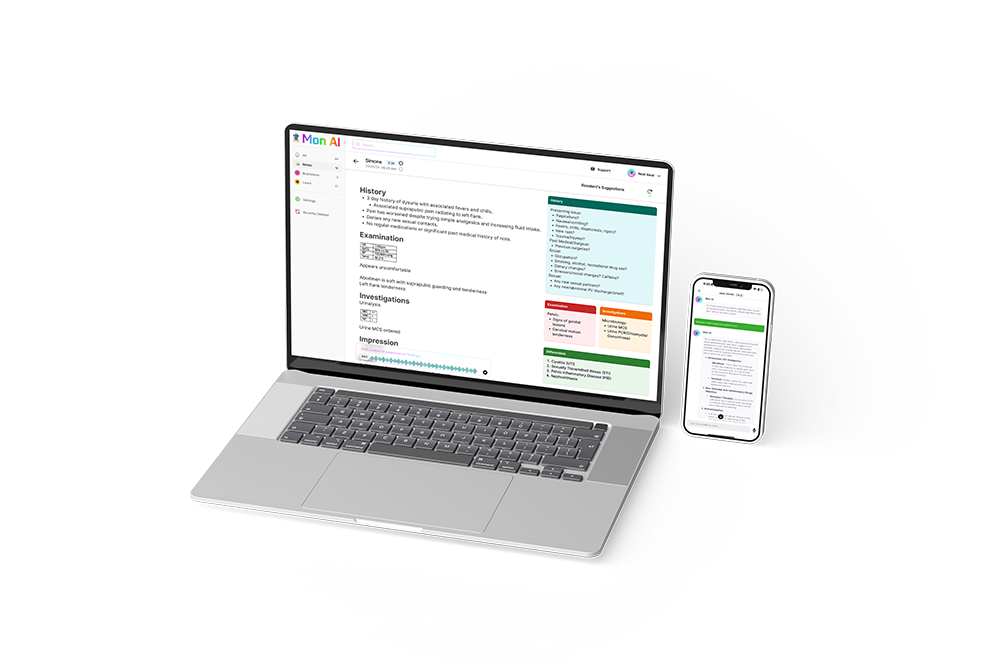
The next generation goes further. True AI medical assistants don't just capture conversation, they transform it into clinically meaningful documentation.
Medical Summarisation
AI understands context, extracts key findings, structures notes appropriately
Writes Letters and Referrals
Automatically converts notes into referral/insurance letters and even provide patient handouts to further improve care
Decision Support
Real-time clinical insights, evidence-based recommendations, and care gap identification
The ROI of Time: Reclaiming What Matters Most
Let's talk numbers (because behind every statistic is a real GP making real decisions about their career)
Dr. Sarah Chen has started using an AI scribe for just six months. Her experience mirrors the research: UCLA Health studies show AI scribes reduce documentation time by up to 2 minutes per patient.5
Two minutes sounds small. But across 25 patients per day, 5 days a week? That's over 4 hours saved weekly. Over a year, it's more than 200 hours - the equivalent of five full work weeks.
The Permanente Medical Group reported saving 15,791 hours across their organization after implementing AI scribes.6 That's not just efficiency, that's professional sustainability.
Calculate your own potential savings ↓
Time Savings Calculator
Discover how much time and money you could reclaim with AI-powered documentation
Your Potential Savings
Your cost represents just 4.2% of what you gain back
Ready to Reclaim Your Time?
Join hundreds of Australian GPs who have already discovered what it means to finish work when the workday ends (not hours later)
No credit card required. No time limits.