The "American" AI Problem: Why Australian Doctors Need Localised Decision Support
When an AI suggests a medication that isn't on the PBS or follows guidelines from another country, it makes more administrative work and introduces a new layer of risk. The hidden risks of non-localised clinical AI.
Artificial Intelligence is flooding into Australian clinics. From scribing tools to chatbots, the promise is the same: efficiency, accuracy, less administrative burden. But there's a dangerous blind spot in many of these tools that even experienced practice managers can overlook: Geography.
Medicine is not universal. The clinical guidelines for managing Type 2 Diabetes in Boston are not the same as in Brisbane. The PBS listings in Australia differ vastly from US insurance formularies. When a generic Large Language Model is trained on internet data, it defaults to the loudest voice, and that voice is overwhelmingly American.
The Risks of "Global" Models in Local Clinics
When AI tools don't understand the Australian healthcare context, the consequences can range from frustrating to dangerous. Here's what's at stake when clinical decision support isn't locally calibrated.
Medication Errors
A generic AI might suggest a dosage or brand name available in the US but inappropriate under the Australian PBS. Medication errors remain a leading cause of preventable harm in Australian healthcare.1
Guideline Divergence
Australian guidelines often differ significantly from international protocols. An AI relying on US data might recommend unnecessary treatments, increasing cost and side effects for patients.
System Friction
Referring to "Specialists" or "Emergency Rooms" without understanding Australian referral pathways creates confusion and delays in an already stretched system.
See the Difference: US vs Australian Guidelines
Click on a condition to see how clinical guidance differs between US and Australian protocols
Mild Persistent Asthma
Often recommends low-dose ICS + LABA as initial controller therapy, or LTRA alternatives based on patient preference.
Mild Persistent Asthma
Recommends low-dose ICS as first-line controller. Combination ICS/LABA only for moderate-severe cases. Strong emphasis on preventer education.
- Australian guidelines emphasise preventer-first approach earlier in treatment
- PBS restrictions may make some US-recommended combinations unavailable or restricted
- Brand names differ (e.g., Symbicort vs Pulmicort formulations vary by market)
First-Line After Metformin
SGLT2 inhibitors or GLP-1 receptor agonists recommended based on comorbidities. Cost often covered by insurance with prior authorization.
First-Line After Metformin
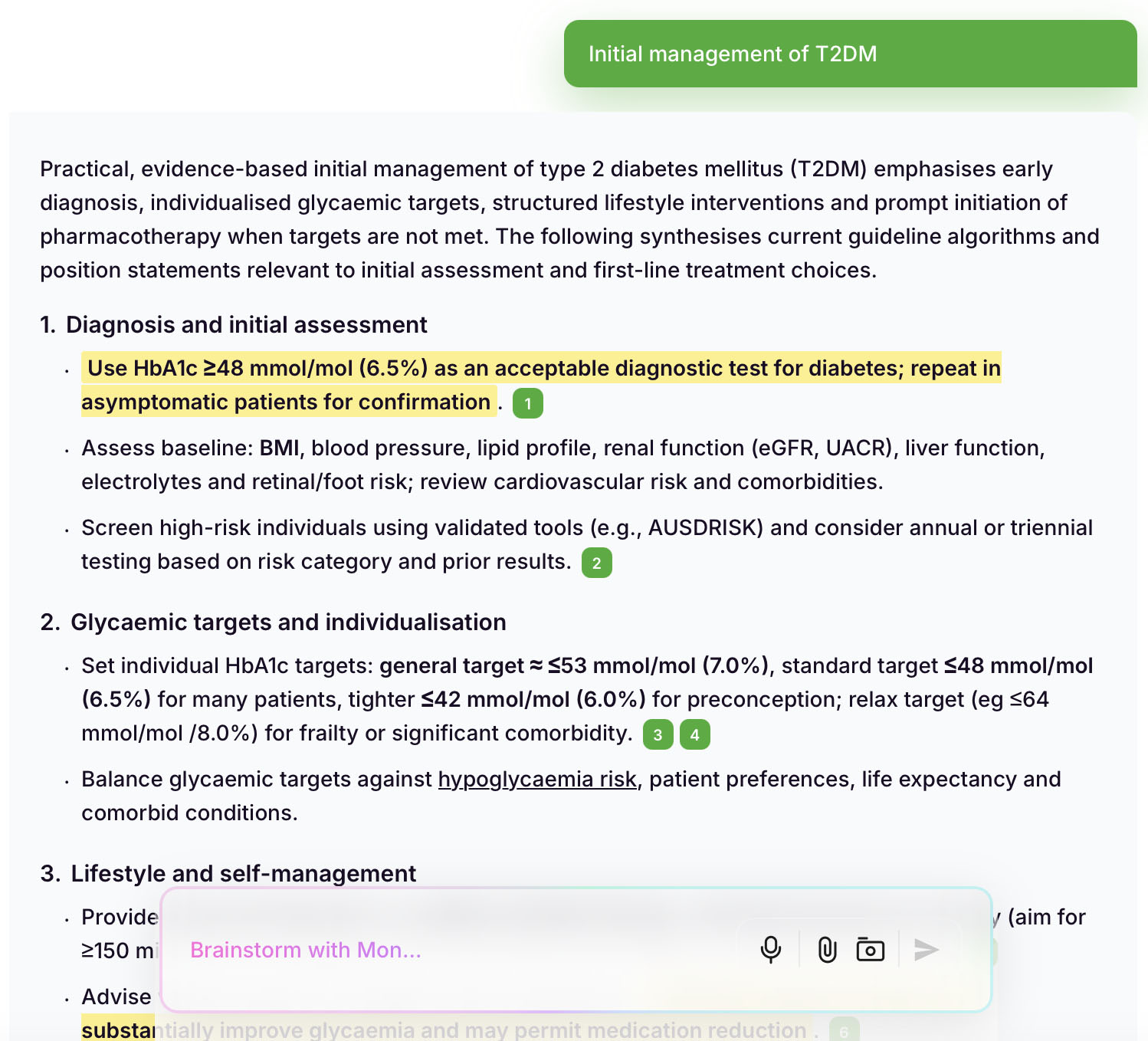
Sulfonylureas or DPP-4 inhibitors often first due to PBS cost. SGLT2/GLP-1 require specific criteria (HbA1c thresholds, comorbidities).
- PBS subsidy criteria significantly impact what's affordable for patients
- Australian guidelines prioritize agents with PBS general availability
- HbA1c thresholds for PBS approval differ from US clinical recommendations
Blood Pressure Targets
Defines hypertension at ≥130/80 mmHg. Recommends treatment for Stage 1 (130-139/80-89) with high cardiovascular risk.
Blood Pressure Targets
Hypertension defined as ≥140/90 mmHg. Target generally <140/90, or <130/80 for high-risk patients. More conservative treatment initiation.
- US focus on only BP control while Australian guidelines suggests modifications in view of Heart Health
- Australian approach integrates absolute CVD risk assessment more centrally
- First-line medication preferences differ (ACEi/ARB vs thiazide emphasis)
The Solution: Context-Aware Intelligence
At Mon AI, we recognized that a "smart scribe" isn't enough. We needed a "clinical assistant." Our architecture doesn't just listen and type, it reasons through a localised lens. By anchoring our AI to Australian clinical guidelines and the PBS, we ensure that the decision support it provides is relevant, safe, and immediately actionable for an Australian doctor.
Our system checks recommendations against PBS criteria, references Australian-specific guidelines, and understands the local referral landscape. When a doctor asks about hypertension management, they receive guidance aligned with Heart Foundation recommendations, not ACC/AHA thresholds that could lead to poor optimisation.
✓ Built for Australian Practice
Mon AI integrates directly with Australian clinical resources and databases. Every recommendation is filtered through the lens of local availability, cost, and guideline alignment. This ensures that all suggestions can actually be prescribed, referred, or actioned within the Australian healthcare system.
Is Your AI PBS-Aware?
As AI adoption grows, localisation must become the gold standard. Australian doctors deserve tools that understand their patients, their formularies, and their guidelines. It might be time to check what your current AI is recommending.
See How Mon AI Handles Australian GuidelinesBuilt for Australian healthcare. Aligned with the PBS and local clinical pathways.